

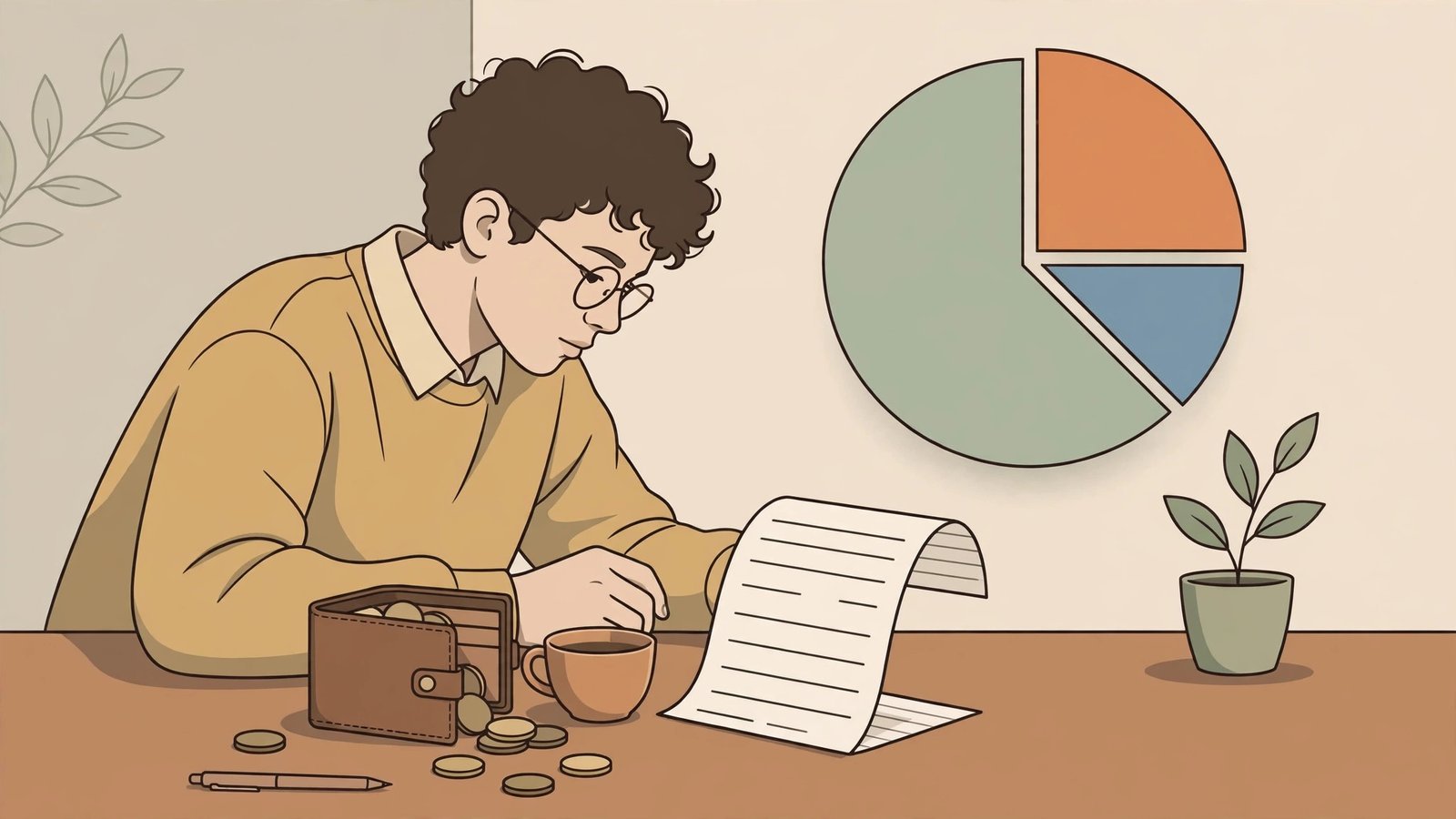
To budget your first paycheck, start with your take-home pay — the money that actually lands in your bank account — and split it into three buckets: 50% for needs, 30% for wants, and 20% for savings and debt payments. The single biggest mistake first-timers make is budgeting from the salary number on the offer letter. Your paycheck is always smaller than that figure, and this walkthrough shows you exactly where the rest goes, with a real worked example.
Why Is My Paycheck Smaller Than My Salary?
This surprises almost everyone. You were offered, say, $52,000 a year, which sounds like $2,000 every two weeks — until payday arrives and the deposit is closer to $1,567. The gap isn’t an error. It’s deductions.
Here’s what a typical $2,000 biweekly gross pay stub looks like, line by line:
- Gross pay: $2,000.00 — what the offer letter promised per pay period.
- Federal income tax: ~$180 — varies by income, state, and the W-4 form you filled out.
- State income tax: ~$60 — some states take nothing; others take a chunk.
- Social Security: $124 (6.2% of gross, automatic).
- Medicare: $29 (1.45% of gross, automatic).
- Health insurance premium: ~$40 — if you enrolled in your employer’s plan.
- Take-home pay: ~$1,567 — this is your real budget number.
Your budget starts at $1,567, not $2,000. That one adjustment — budgeting from net pay instead of gross — is the difference between a plan that works and one that quietly falls apart by week three.
How to Budget Your First Paycheck With the 50/30/20 Rule
The 50/30/20 rule is the simplest budget that actually works for beginners. You divide your take-home pay into three buckets:
- 50% — Needs. Non-negotiables: rent, groceries, utilities, transport, phone bill, insurance, and minimum debt payments.
- 30% — Wants. The fun stuff: eating out, clothes, streaming services, hobbies, weekend plans.
- 20% — Savings and debt. Emergency fund, retirement contributions, and any payments above the minimum on debt.
Applied to our $1,567 take-home example:
| Bucket | Share | Amount |
|---|---|---|
| Needs | 50% | ~$784 |
| Wants | 30% | ~$470 |
| Savings + extra debt | 20% | ~$313 |
Notice what this does psychologically: it gives spending permission. Most first paychecks vanish because there’s no plan at all, or because the plan was “save everything” and collapsed by day four. A budget that officially allows $470 of wants is a budget you can actually live with.
What Do I Do With the 20% Savings Part?
This is where beginners get vague, so be specific. Your first savings target isn’t retirement — it’s a starter emergency fund of $500 to $1,000. That cushion is what stops a flat tire or a broken phone from becoming credit-card debt.
Three practical moves for the savings bucket:
- Automate the transfer. Set your bank to move $313 (or your 20%) to savings on payday, before you can spend it. “Pay yourself first” is a cliché because it works.
- Use a separate account. Ideally a high-yield savings account at a different bank than your checking — the slight friction of moving money back makes impulse raids less likely.
- Grab free money first. If your employer matches retirement contributions (a 401(k) match), contribute at least enough to get the full match before building the emergency fund past $1,000. It’s an instant 100% return.
What Are the Common First-Paycheck Mistakes?
Lifestyle creep on day one. The paycheck feels big until rent, groceries, and transport claim their shares. Hold off on the apartment upgrade, the new car, or the furniture splurge for at least three months — live on the 50/30/20 split first and see what’s real.
Subscriptions you signed up for and forgot. Streaming trials, app subscriptions, that gym you joined in January energy — they all draw from the wants bucket. A quick audit of your bank statement once a quarter catches them.
Waiting until “next month” to start. The perfect budget never arrives. A rough 50/30/20 split started today beats a flawless spreadsheet started in six months.
Treating savings as whatever’s left. If savings is last in line, there’s never anything left. That’s why the automated transfer on payday matters more than the exact percentages.
When Should I Adjust the Split?
50/30/20 is a starting point, not a law. If you live in an expensive city and rent alone eats 50%, you’re not failing — you need a different split, like 60/20/20, or a roommate. The rule’s real value is the structure: needs first, wants bounded, savings non-negotiable. Tweak the percentages to fit your reality, but never let savings drop to zero without a plan to restore it.
Try This: The Seven-Day Snapshot
Here’s a small experiment that makes your first budget dramatically more accurate. For the seven days after payday, write down every dollar you spend — a notes app is fine. Don’t judge the spending; just record it. At the end of the week, sort the list into needs, wants, and savings. Almost everyone discovers one surprise subscription and one category (usually food delivery or coffee) that’s twice as big as they guessed. That single week of data turns your second paycheck’s budget from a guess into a plan.
FAQ
How much should I save from my first paycheck?
Aim for 20% of your take-home pay. If that’s a stretch, start at 10% and raise it by one percentage point each month. The habit of saving on payday matters more than the starting amount.
Should I pay off debt or build savings first?
Do both, in order: build a $500–$1,000 starter emergency fund first (so new debt can’t sneak in), then attack high-interest debt with the 20% bucket while keeping the emergency fund intact.
What if 50/30/20 doesn’t cover my rent?
Adjust the ratios — try 60% needs, 20% wants, 20% savings — or cut the biggest need directly (roommates, a cheaper place, transit instead of a car). A budget that ignores your real rent isn’t a budget; it’s a wish.
How long does it take for budgeting to feel normal?
About three pay periods. The first month is awkward, the second is adjustments, and by the third, the split runs on autopilot — especially if the savings transfer is automated.