

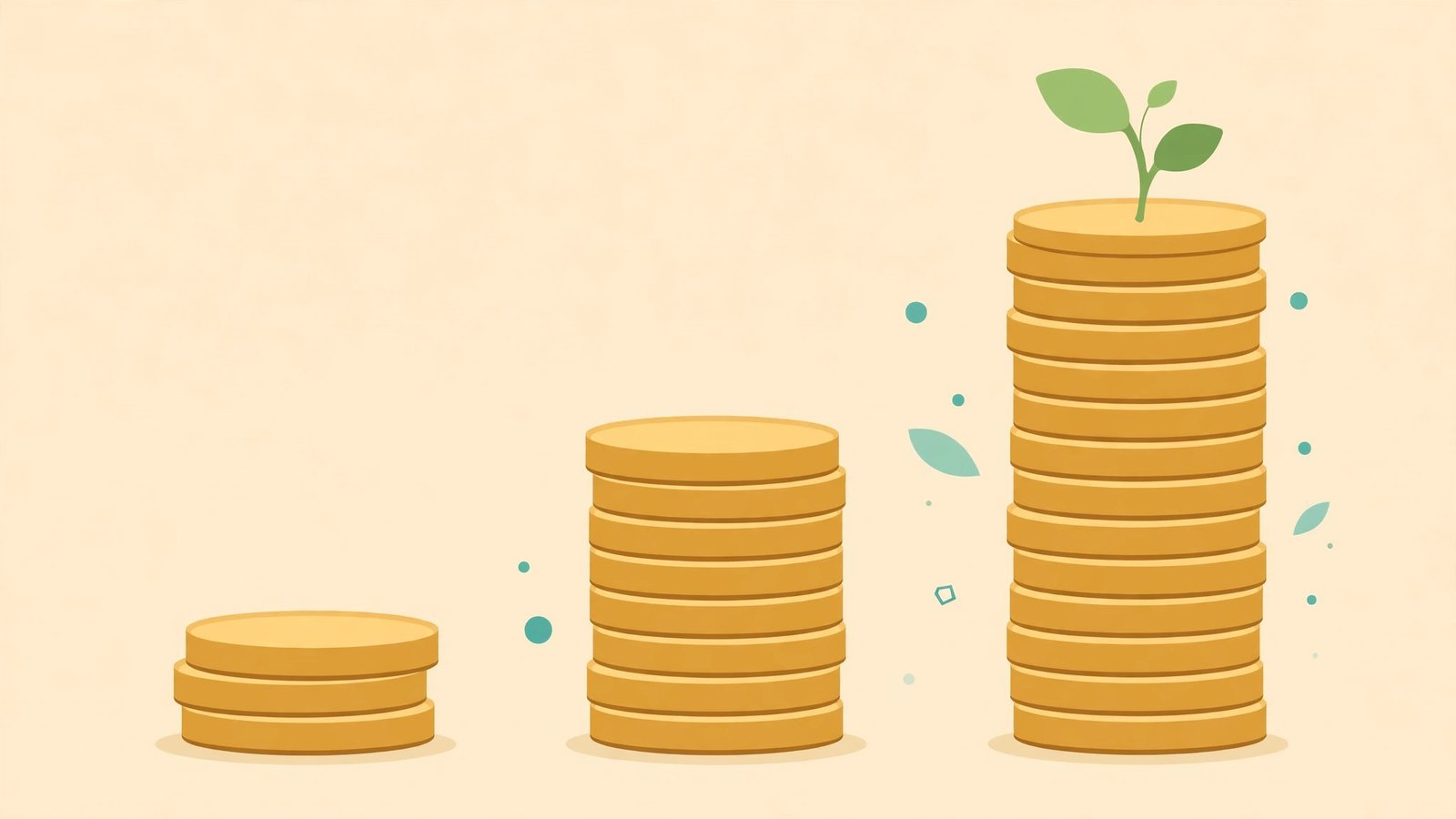
Compound interest is interest that earns interest of its own. When you save or invest money, you earn interest on your original deposit — and then, in the next period, you also earn interest on the interest you already earned. That snowball effect is why a small amount saved early can quietly grow into far more than a larger amount saved late.
What Is Compound Interest in Simple Terms?
Imagine you put $100 in a savings account that pays 10% interest a year. After year one, you have $110. In year two, the 10% is calculated on $110, not $100 — so you earn $11, and you now have $121. In year three, you earn 10% on $121, which is $12.10. Each year, the amount you earn grows, because the base it is calculated on keeps growing.
That is the whole idea. Simple interest, by contrast, pays the same $10 every year on the original $100, forever. Compound interest pays a little more every year. The difference looks tiny at first — and then, over years and decades, it becomes enormous.
The $200-a-Month Story: Start at 22 or 35?
The clearest way to feel compound interest is to watch two savers with the same habit and different start dates.
Maya starts at 22. She puts $200 a month into an account earning an average of 7% a year, compounded monthly. She keeps going until she is 65. Total money she puts in: about $103,200.
Jordan starts at 35. Same $200 a month, same 7% return, same stop at 65. Total money Jordan puts in: about $72,000.
Maya contributed only about $31,000 more than Jordan. But at 65, Maya’s balance is roughly $680,000 — while Jordan’s is roughly $264,000. Maya ends up with more than two and a half times as much money, mostly because her money had 13 extra years to compound.
Jordan did nothing wrong. He saved the same amount every month at the same rate. He simply started later, and those 13 missing years were the most powerful years in the whole timeline — the years when the snowball was already big and growing fast.
This is the single most important lesson about compound interest: time in the account matters more than the amount you start with.
How Does Compound Interest Actually Work?
Three ingredients decide how much compound interest you earn:
1. The principal — how much you start with. This is your original deposit. Bigger principal, bigger growth, but as Maya showed, starting with a small principal early still beats a big one late.
2. The interest rate — how fast it grows. A higher rate compounds faster. The difference between 3% and 7% over 30 years is not double — it is many times over, because the rate compounds on itself too.
3. Time — how long you leave it alone. Time is the ingredient you can never buy back. Every year you wait is a year of compounding lost, and the lost years are the expensive ones at the end, when the balance is largest.
There is also a fourth factor: how often interest compounds. An account that compounds monthly grows slightly faster than one that compounds yearly at the same rate, because the interest starts earning interest sooner. The difference is small, but it is real.
A Quick Formula (If You Like Numbers)
You do not need the formula to use compound interest, but it shows why the curve bends upward:
A = P (1 + r/n)^(nt)
- A is the final amount
- P is the principal (what you start with)
- r is the annual interest rate (as a decimal — 7% is 0.07)
- n is how many times interest compounds per year
- t is the number of years
Try it with $1,000 at 7% for 30 years: $1,000 × (1.07)^30 ≈ $7,612, versus $3,100 at simple interest. That gap is compound interest doing its work.
The Rule of 72: A Shortcut Worth Memorizing
Divide 72 by your annual interest rate to find roughly how many years it takes your money to double.
- At 6%: 72 ÷ 6 = 12 years to double
- At 8%: 72 ÷ 8 = 9 years to double
- At 10%: 72 ÷ 10 = about 7 years to double
So money earning 7% doubles roughly every 10 years. That means $5,000 saved at 22 becomes about $10,000 at 32, $20,000 at 42, $40,000 at 52, and $80,000 at 62 — without adding another dollar. Each doubling takes the same amount of time, but each one adds more money than the last.
Where Does Compound Interest Show Up in Real Life?
Savings accounts and certificates of deposit. Your bank pays interest, and the interest stays in the account earning more interest — as long as you do not withdraw it.
Retirement accounts (401(k)s and IRAs). The money you invest buys assets that grow, and the growth is reinvested to buy more assets. Over a 30- or 40-year career, compounding does most of the heavy lifting — most people’s retirement balances are mostly growth, not contributions.
Investing in the stock market. When a company pays dividends and you reinvest them, you buy more shares, which pay more dividends, which buy more shares.
And the flip side: debt. Compound interest also works against you on credit cards and loans. When unpaid interest is added to your balance, next month’s interest is charged on the bigger balance. This is why a credit card balance paid only at the minimum can take years to clear.
How Can I Start Using Compound Interest Today?
You do not need a lot of money. You need a start and a habit.
Open an account that pays interest. A high-yield savings account is the simplest place to begin — your money earns interest and stays accessible. If your employer offers a retirement plan with a match, contribute at least enough to get the full match.
Automate a small amount. Set up an automatic transfer of even $25 or $50 per paycheck into savings or investments. Automation matters because willpower is unreliable, and consistency is what compounding feeds on.
Leave the growth alone. The hardest part of compound interest is doing nothing. Every withdrawal resets the snowball.
Increase slowly over time. When you get a raise, bump your automatic contribution by a little. A $50 monthly increase at 25 can be worth tens of thousands by retirement — and you will barely feel it.
The One Mistake to Avoid
The most common mistake with compound interest is waiting for the “right time” — for a bigger paycheck, a lump sum, or a better understanding of investing. There is no right time, because the math rewards starting, not waiting. A $25 monthly habit started today beats a $100 monthly habit started five years from now. The perfect plan you start next year loses to the imperfect plan you start today.
Why Compound Interest Matters More Than Picking the “Best” Investment
Beginners often spend months hunting for the highest return or the perfect investment. That effort rarely matters as much as two boring decisions: start now, and keep going. A person earning an average 7% for 40 years will beat a person earning 10% for 20 years almost every time.
Compound interest is not a trick. It is the patient arithmetic of money growing on itself. The earlier you let it start working, the less you will need to do later.
Frequently Asked Questions
What is compound interest in simple terms?
Compound interest is interest earned on both your original money and the interest it has already earned, so your balance grows faster over time.
How is compound interest different from simple interest?
Simple interest is calculated only on the original principal, so you earn the same amount every period. Compound interest is calculated on the principal plus all interest earned so far, so what you earn grows every period.
What is a real example of compound interest?
If you save $200 a month at 7% a year from age 22 to 65, you put in about $103,200 and end up with roughly $680,000. Starting at 35, the same habit gives you only about $264,000 — those 13 extra years of compounding are worth over $400,000.
Does compound interest work with a small amount of money?
Yes. Compound interest works at any amount — even $25 a month grows meaningfully over decades, because time matters more than the starting amount.