
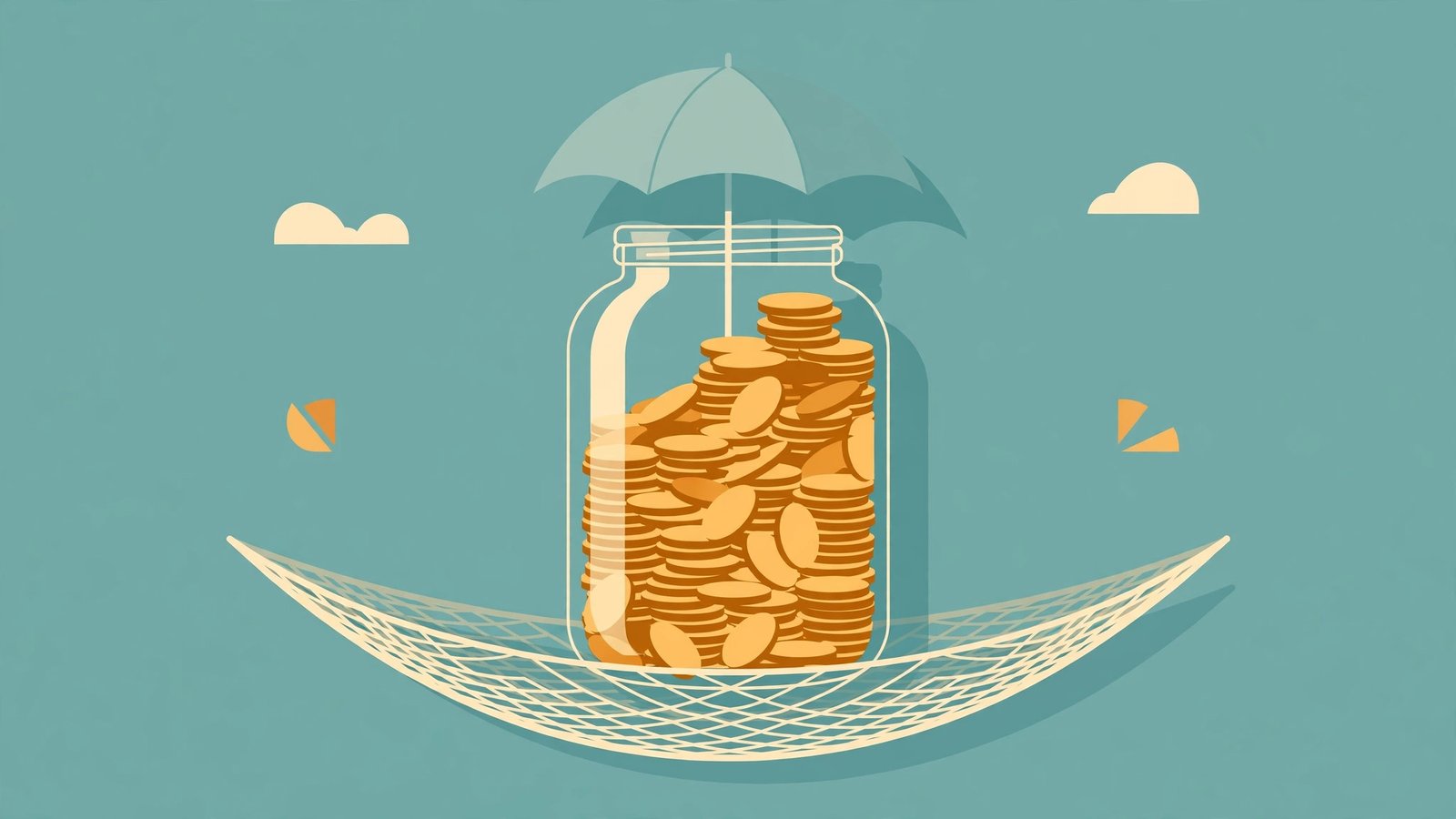
To build an emergency fund from scratch, open a separate savings account, save a $1,000 starter fund first, then automate a fixed weekly transfer and grow it toward three to six months of essential expenses. The starter fund covers the most common real-world emergencies — car repairs, a broken phone, a surprise bill — and most beginners reach it in two to three months.
That’s the whole strategy in one paragraph. Everything below is the how: the exact setup, the psychology that makes it stick, and the mistakes that quietly kill most people’s attempts before they reach month two.
What counts as an emergency fund, really?
An emergency fund is cash you can touch within a day or two, kept separate from the money you spend, and reserved for things that are both unexpected and urgent. A blown tire is an emergency. A holiday sale is not. A broken water heater is an emergency. A new phone because you’re bored is not.
The line matters because most “emergency funds” die from a fuzzy definition, not a lack of discipline. If the money sits in your checking account next to your grocery money, every purchase feels equally justified. Separation is the entire game: a different account, ideally at a different bank, that you never see when you open your banking app.
Don’t invest it, either. Stocks can drop 20% the week your car breaks down. A plain high-yield savings account is the right home: liquid, boring, and earning a little interest.
Why start with $1,000 instead of three months of expenses?
Most guides tell you to save three to six months of expenses. For someone starting from zero, that’s paralyzing advice: three months might be $6,000 or $9,000, and staring at that number from zero means never taking the first step.
The starter-fund method flips the order: save $1,000 first, then climb toward the big number. One thousand dollars is reachable yet life-changing. Look at what real emergencies cost: the average car repair runs $500–$600, a cracked phone screen $200–$300, an urgent-care visit around $150–$250. A $1,000 cushion absorbs nearly all of them.
There’s a psychological payoff too. Reaching your first $1,000 proves you are someone who saves money. That shift — from “I’m bad with money” to “I have savings” — carries you through the longer second phase.
Where should you keep your emergency fund?
Three rules for the account: separate, liquid, and slightly inconvenient.
Separate means its own savings account, not a corner of your checking. Many people open it at a different bank on purpose — if it’s not visible in your main banking app, you won’t spend it by accident.
Liquid means you can get the money within one to two business days without penalties. A high-yield savings account qualifies. Certificates of deposit, retirement accounts, and investments do not.
Slightly inconvenient means no debit card attached and no instant transfers to your checking. A one-day delay is a feature: it forces every “emergency” to survive 24 hours of scrutiny, and most fake emergencies don’t.
A high-yield savings account at an online bank hits all three. You can open one in about 15 minutes with no minimum balance.
How do you build an emergency fund from scratch when money is tight?
This is the question that matters most, because “just save more” isn’t advice — it’s a taunt. Here’s the concrete method, built for people who feel like there’s nothing left at the end of the month.
Step 1: Find your first $25. Not per week — total. Sell one thing you don’t use, return one impulse purchase, or skip one subscription for a month. The amount doesn’t matter; the account-opening moment does. An empty savings account feels hypothetical. One with $25 in it feels real.
Step 2: Automate a weekly transfer on payday. Log into your bank and schedule an automatic transfer from checking to your emergency savings the day after each paycheck lands. Start with whatever survives contact with reality — $20, $30, $50. Weekly beats monthly here: smaller amounts hurt less, and the habit builds four times faster.
Step 3: Capture windfalls before you feel them. Tax refunds, cashback, birthday money, a sold gadget — route a fixed share (half is a good rule) straight to the fund before the money lands in your spending account. Windfalls are the fastest accelerant most beginners have, precisely because you never had the money to miss.
Step 4: Raise the transfer when you can, never lower it. Got a raise, paid off a bill, or finished a subscription? Move half the freed-up cash into the weekly transfer. The rule is one-directional: transfers only go up. You adjust to each new amount within two weeks and forget it was ever lower.
Here’s what the math looks like for a realistic beginner. Say you bring home $400 a week and start with a $25 weekly transfer. That’s $100 a month — your $1,000 starter fund arrives in about 10 months. Bump it to $50 a week ($200/month) and you’re there in 5 months. Add one $300 tax refund at the halfway mark and you’re done in under 4. The point isn’t the exact timeline — it’s that every version of this math ends with a funded account, while “I’ll start when I earn more” ends with nothing.
How much should your emergency fund actually be?
Once the $1,000 starter fund is done, the real target is three to six months of essential expenses — rent, utilities, groceries, transport, insurance, minimum debt payments. Not dining out, not subscriptions, not shopping.
Three months is the floor for most people: enough to absorb a job loss. Six months fits freelancers, single-income households, and anyone in a volatile industry. More than six is usually overkill — at that point the cash works harder invested or aimed at debt.
A shortcut if the full calculation feels like homework: take one month of essential expenses, multiply by three, and make that your phase-two goal. Done beats precise.
When is it okay to use the money?
Use it when the expense is unexpected, urgent, and necessary — all three. The furnace dies in January: yes. The car needs brakes to pass inspection: yes. Concert tickets or a vacation deal: no.
Here’s the part most guides skip: using the fund is not failing. The fund exists to be used. The only rule: the week after you spend from it, the automatic transfers resume and rebuilding becomes the priority until you’re whole again. A fund that saves you twice is a tool; one you never touch is a trophy.
What kills most emergency funds (avoid these)
Keeping it in checking. If you can see it next to your spending money, you will spend it. Separate account, different bank if needed.
Starting too big. A $100 weekly transfer you cancel in week three builds nothing. A $25 transfer that runs for a year builds $1,300. Start embarrassingly small.
“Borrowing” from it for non-emergencies. The fund survives on a bright line: unexpected, urgent, necessary.
Waiting for the perfect month. There is no perfect month. The $25 you move today matters more than the $500 you plan to move “soon.”
FAQ
How long does it take to build an emergency fund from scratch?
Most beginners reach the $1,000 starter fund in two to five months with weekly transfers of $25–$50 plus an occasional windfall. The full three-to-six-month fund typically takes one to two years — which is fine, because the starter fund protects you during the climb.
Can I build an emergency fund if I live paycheck to paycheck?
Yes — start with a single $25 deposit and a $10–$20 weekly automatic transfer. Small transfers you never cancel beat ambitious ones you abandon. Windfalls (refunds, sold items, bonuses) accelerate the timeline dramatically.
Should I pay off debt or build an emergency fund first?
Build the $1,000 starter fund first, then attack high-interest debt. Without the starter fund, every surprise expense lands on a credit card and the debt cycle restarts. Once high-interest debt is gone, grow the fund to three to six months of expenses.
Is $1,000 really enough for an emergency fund?
It’s enough for the most common emergencies — car repairs, appliance failures, medical copays, a broken phone — which is exactly what derails beginners. Think of it as phase one. Phase two is three to six months of essential expenses, built on the same automatic system.